
Why Your Feet Hurt During Pickleball (And What To Do About It)
Article Summary
Heel or arch pain during pickleball is often caused by plantar fasciitis, a condition that usually builds up gradually from repeated stress rather than one sudden injury
Pickleball places high demands on the feet through stopping, cutting, lunging, and long hours on court, especially when calf strength or foot control are lacking
Stretching, massage, and orthotics can help symptoms, but long-term improvement usually requires strengthening the calves, improving arch control, and building better load tolerance
Rehab should eventually progress toward pickleball-specific movements like hopping, landing, balance, and change-of-direction drills so the foot can better handle the demands of play
Most people do not need to stop playing completely — managing irritation, staying active, and being consistent with rehab are usually the keys to getting back to pain-free pickleball
If you’ve started playing pickleball more often and your feet are yelling at you every morning when you get out of bed… you’re definitely not alone.
A common pattern I see is patients describing:
sore steps first thing in the morning
pain around the heel or arch
feet feeling “tired” after standing or playing for a long time
soreness after a big tournament weekend or vacation with lots of walking
feet that somehow feel best in one specific pair of slippers or shoes
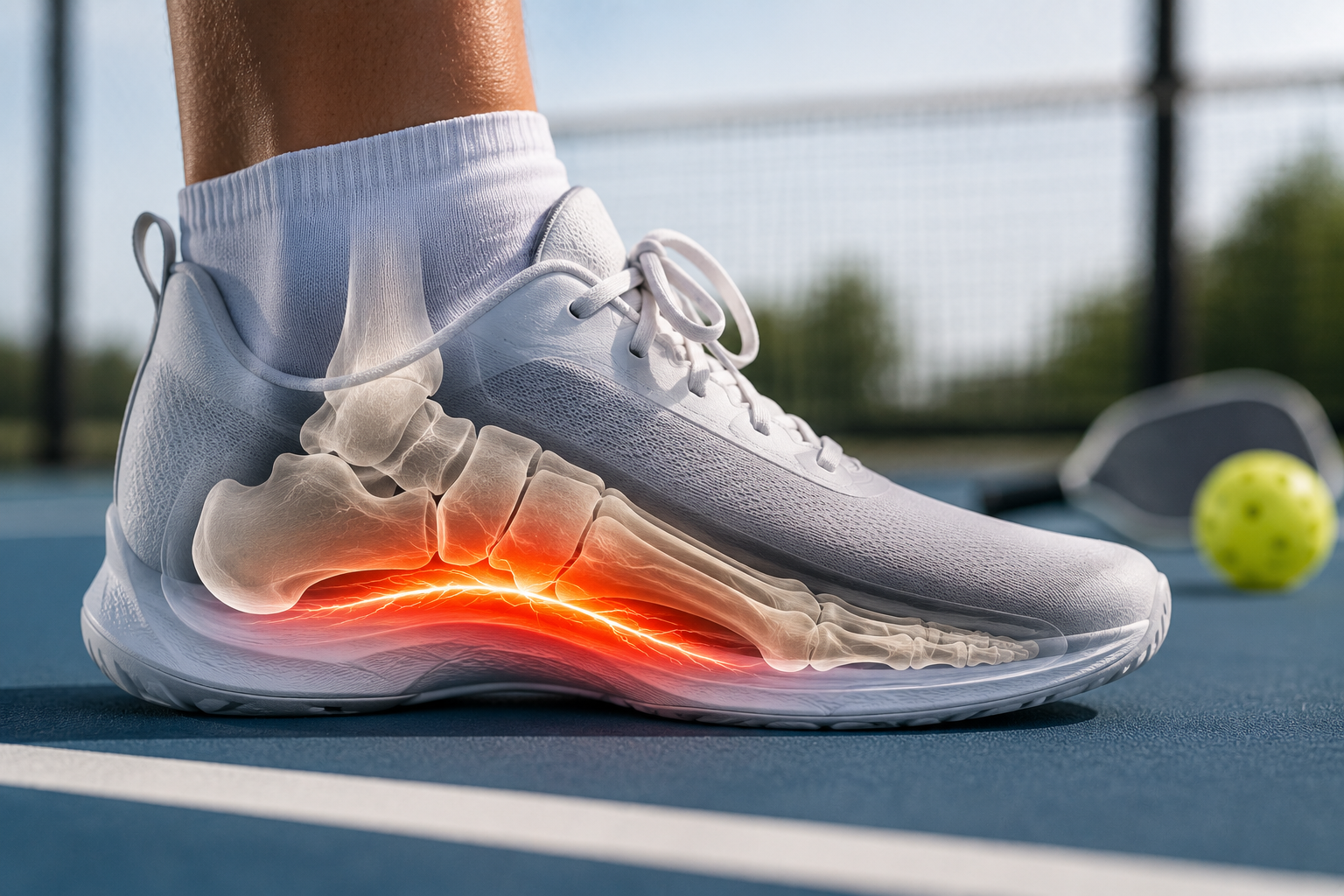
One of the most common culprits, and one that I see often in my practice, is plantar fasciitis.
What is plantar fasciitis?
Your plantar fascia is connective tissue that spans the gap on the bottom of your foot between the front edge of your heel and the ball of your foot.
Its job is to absorb and transfer force and to provide structural support for the arch of your foot.
Plantar fasciitis simply means inflammation (-itis) of the plantar fascia and it can happen for a number of reasons.
The Annoying Thing About Plantar Fasciitis
Plantar fasciitis can be frustrating because it’s usually not the kind of injury where something dramatic happens.
It’s different from something like an ankle sprain where you know the exact moment it started.
Instead, it slowly builds over time.
You start noticing:
“Hmm, my heel’s a little sore in the morning.”
Then a few weeks later:
“Okay, now my feet are angry after pickleball too.”
Then eventually:
“My DUPR will never go up.”
(I promise, it’s just your feet).
Why Pickleball Can Flare It Up
Pickleball asks your feet to do a ton of work.
You’re:
stopping and starting constantly
changing direction quickly
loading the balls of your feet
pushing off side to side
spending long periods standing between games
sometimes playing for HOURS at tournaments or rec days
That’s a lot of repeated force going through the foot.
And all that load has to go somewhere.
When we look at the anatomy of the lower leg it goes something like this:
Calf → Achilles tendon → heel → arch → plantar fascia
Everything’s connected.
If one of these areas stops contributing to activity in the way that it should, other structures will have to pick up the slack.
So for example, if you have very tight calves and poor foot control, the load from all that lunging can go straight into the arch of your foot and begin to irritate it over time.
Foot structure plays a role
One thing I’ve dealt with as an athlete is extraordinarily flat feet, to the point where it was a large part of my personality through portions of elementary and middle school.
Growing up, I always wondered how this would affect my ability to compete and stay active. While it certainly has been something I have to consider, it’s not the death sentence that some people might make you think it is.
Similarly, people with high arches will often wonder how much this might affect their ability to participate in sports like pickleball.
The truth is flat feet and high arches aren’t “bad,” but they change the demands.
It doesn’t mean your feet are broken.
It just means you may rely a little more on muscular control instead of structural support.
In other words, if your arch doesn’t naturally hold itself up very well, your muscles have to help out more.
That’s actually good news, because muscular control is trainable.
The Big Mistake: Only Trying To Stretch It
A lot of people have been told to:
roll their foot on a ball
stretch their calves
massage the arch
wear inserts
And those things can absolutely help symptoms.
But if you stop there, you’ll often miss the bigger picture.
Your foot needs to tolerate load.
Especially if you want to keep playing pickleball.
The goal isn’t just:
“How do I calm this down?”
The goal is:
“How do I make my foot strong enough that pickleball stops irritating it so much?”
What Actually Helps
1. Strengthening The Calves Through Full Range
One of my favourite starting points is controlled calf raises with a heel deficit.
That means standing on a step or box and allowing the heel to drop below the toes before coming back up.
Why?
Because you get:
a really good stretch through the calves
strength in the bottom position
improved load tolerance through the entire movement
And the stronger your body feels in those positions, the less it feels like it has to protect you with pain.
2. Intrinsic Foot Muscle Training
Your feet have small stabilizing muscles that help control the arch.
For a lot of people with plantar fasciitis, these muscles are taking a bit too much time off.
That’s where things like:
arch raises
“piano toes”
toe control drills
can actually be really useful.
It’s not about making your foot look perfect.
It’s about teaching your foot to absorb force better.
3. Gradual Return To Impact
This is a huge one.
Eventually, your rehab needs to look more like pickleball.
We usually start with slower, controlled exercises like calf raises because they’re less dynamic and easier to tolerate.
But as you well know, pickleball isn’t controlled calf raises.
Pickleball is:
hopping
landing
reacting
cutting
absorbing force repeatedly
So eventually we need to teach the body how to handle those things again.
That might mean progressing toward:
light hopping drills
landing mechanics
dynamic balance work
plyometric exercises
The goal is not just reducing pain.
The goal is building a foot that can handle the demands of the sport.
Should You Stop Playing?
Usually not completely.
But sometimes we need to temporarily manage irritation.
If you’re doing a ton of running, jumping, tournaments, or extra activity while the tissue is already irritated, it can just become too much all at once.
That doesn’t mean movement is bad.
In fact, a lot of people feel even worse when they stop moving completely.
Usually we just want to find the sweet spot where:
you keep moving
you keep strengthening
you keep playing to some extent
but you aren’t constantly cranking irritation to a 10/10
Sometimes lower-impact conditioning like the stair master can be a really good temporary option while things calm down and get stronger.
Even something as simple as cutting the number of days that you play pickleball per week from seven to three or four (I know I know it’s a lot to ask) can make a huge difference.
Where Shockwave Therapy Fits In
As with many muscular and tendon-based injuries, shockwave therapy can be incredibly helpful for stubborn plantar fasciitis.
Especially when it’s been around for more than a few weeks.
A lot of chronically irritated plantar fascia becomes less elastic and more prone to further injury over time.
Shockwave uses mechanical pressure waves to stimulate healing activity and encourage the tissue to remodel.
The easiest way to think about it is that we’re trying to wake the tissue back up a little bit.
But the important thing is this:
Shockwave works BEST when combined with exercise.
If we just do passive treatment and never improve strength or load tolerance, the problem often comes back.
Final Thoughts
If your feet hurt every time you try to play pickleball, it doesn’t automatically mean you need to stop playing.
Most of the time, your body just needs a better strategy for handling the load.
That usually means:
improving calf strength
improving arch control
gradually building impact tolerance
managing irritation levels
staying consistent
And honestly, consistency is the hardest part.
Most people know they should do the exercises.
Actually doing them consistently? Different story.
But if you stick with it, most plantar fasciitis cases improve really well over time.
And ideally, we get you back to the point where your feet aren’t the thing stopping you from enjoying pickleball.
For help managing your foot pain book an appointment in downtown Victoria or Royal Oak using the link below